
Counterparts Lite
Localized strings found a good home.
Download (1.5.7) / Buy direct
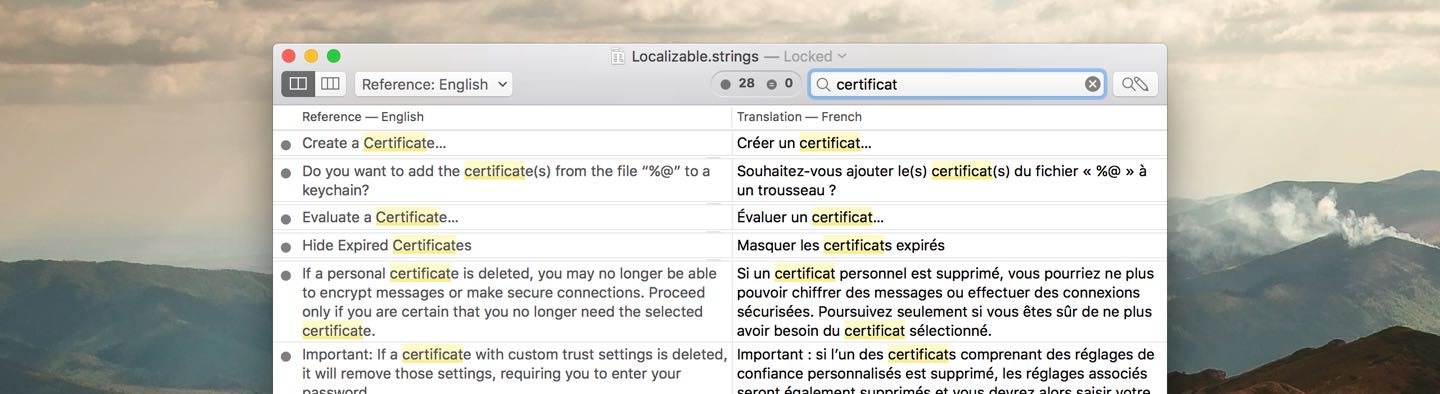
Counterparts Lite makes it clean and simple to edit .string string table files as well as XLIFF files generated by Xcode and some other tools1. Manipulate directly the text in the grid. Use the filter and quick search to look for specific strings. Combine two .string files side-by-side in the same window.
Propagate Translations
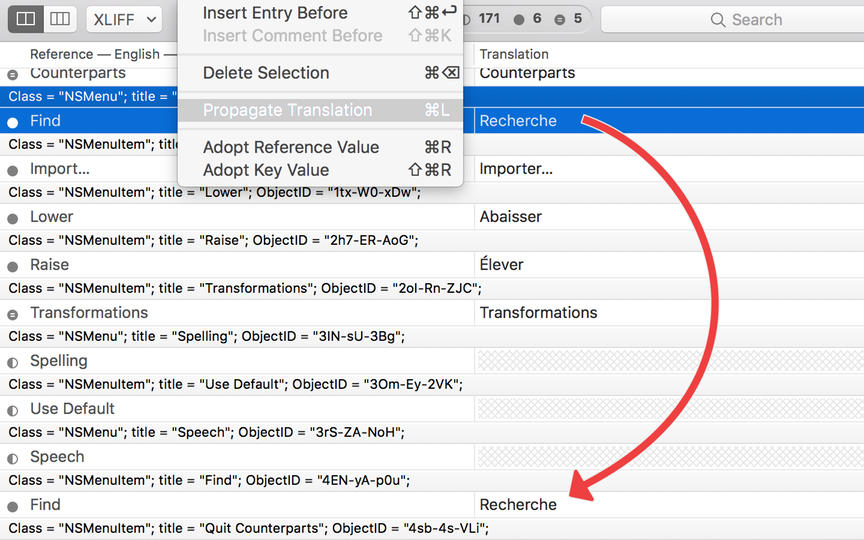
It can be a pain to write the same translation over and over. With Counterparts Lite, you can propagate translations to all rows sharing the same reference text within the document with a single command.
Or just make this automatic with the auto-propagate checkbox in the preferences.
Quickly Found, Swiftly Replaced
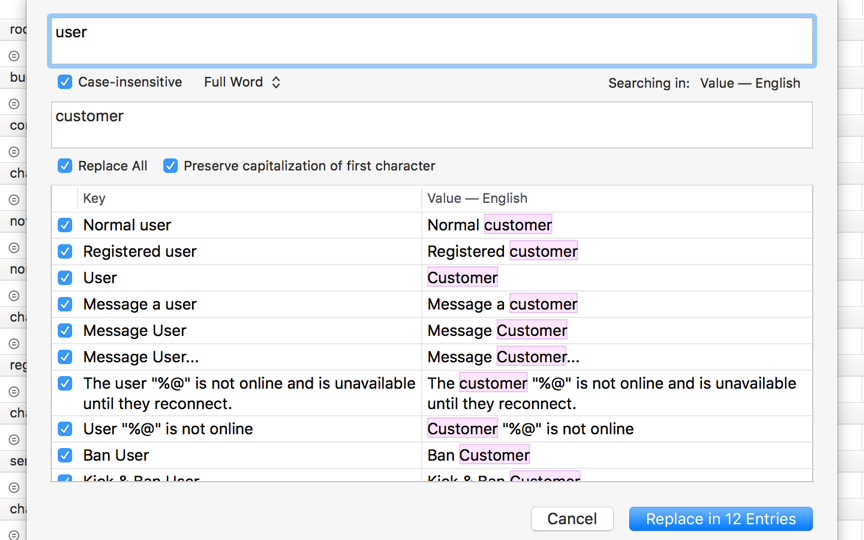
Maybe you need to replace one word everywhere in the document. Find & Replace lets you do that quickly and shows you a preview of the result before actually making the changes.
There’s also a hint of intelligence in the “Preserve capitalization of first character” checkbox to help you with words found at the beginning of a sentence.

State Counters
It’s easy to know how many strings still need to be translated with the state counters in the toolbar. And you can click on the counter to filter rows in a particular state.
| Document with reference | Document without reference |
|---|---|
 Normal row Normal row |
 Normal row Normal row |
 Translation identical to reference Translation identical to reference |
 Value identical to key Value identical to key |
 No translation No translation |
|
 No reference No reference |
Side by Side View
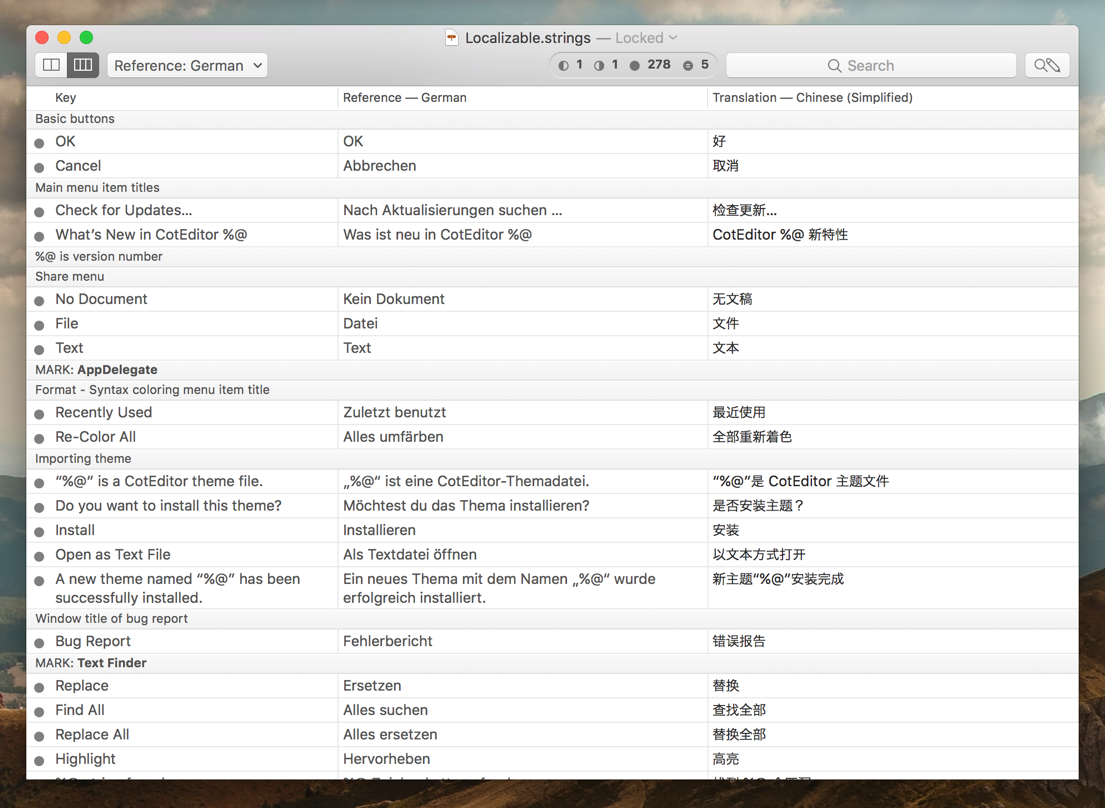
After opening a .strings file, you can choose another file to use as a reference. When setting a reference file, the structure changes to mirror the one in the reference file:
- Ordering of content will be the same as in the reference, with the same comments and “holes” for missing strings.
- Strings in the edited file with no corresponding key in the reference are put at the end, with “holes” in the reference column.
When displaying two files side by side, the Key column is hidden by default, replaced by a column showing the corresponding reference value. You can show the Key column again by switching to three-column mode.
You cannot edit the reference file, nor the keys, while showing two files side-by-side. Side-by-side view is intended for editing a translation of the reference file, not to create new content.
Supported File Types
Counterparts Lite can open the following file formats:
- .strings
- Apple’s string table file format used in most Mac applications. Those files can be either a text file or a binary file. Counterparts Lite can open both text and binary variants. Note that when those files are in binary format comments are not present in the file and ordering is not preserved.
- .xliff .xlf
- XLIFF (XML Localisation Interchange File Format) is a standard format compatible with many localization tools. Counterparts Lite can open XLIFF files produced by other programs and allows editing of the translation strings.
Requirements
- Mac OS X 10.9 Mavericks
-
Counterparts Lite does not support all the functionalities of the XLIFF file format. XLIFF files generated by Xcode are supported. More generally, files with tags or segmentation information within the translation units will lose them once the file is edited in Counterparts Lite. ↩︎